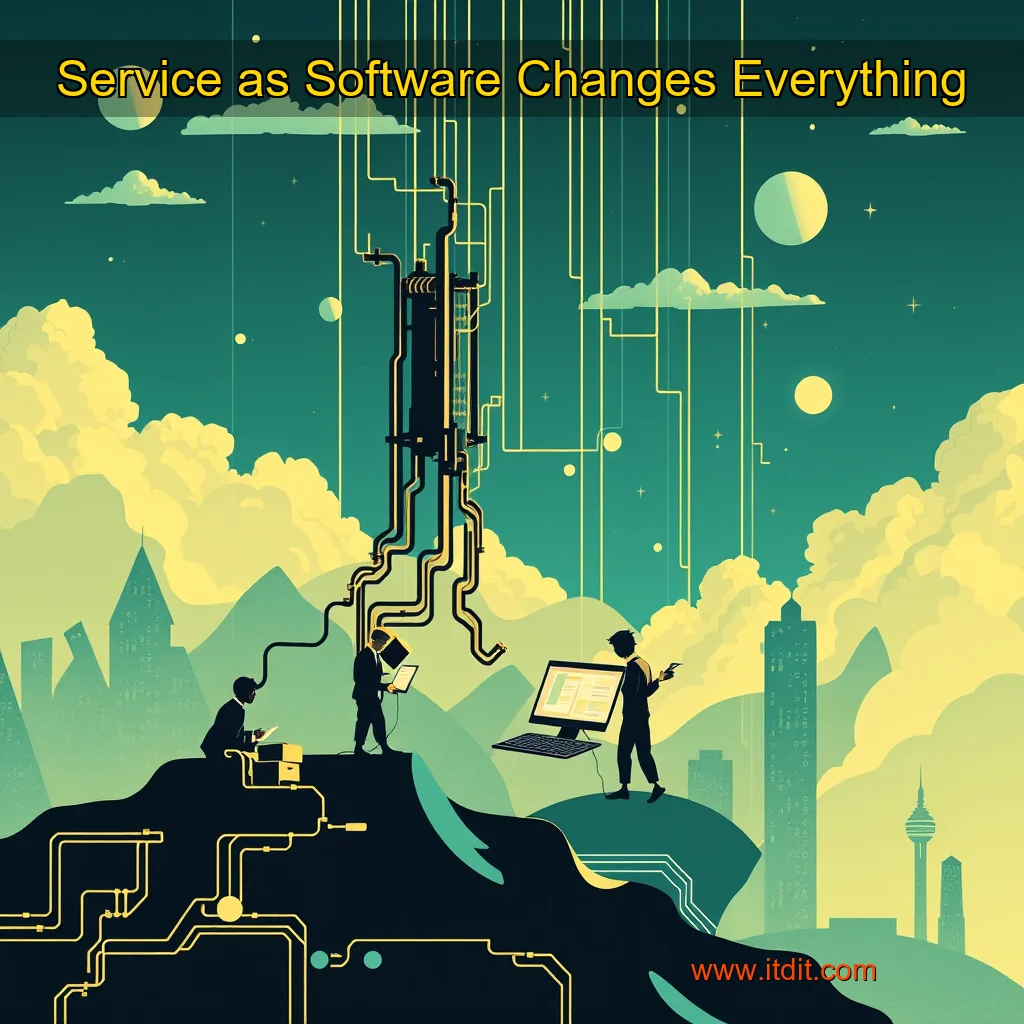
This innovative approach leverages the benefits of both models to provide a more efficient and effective way of delivering services.
The Evolution of Service as a Software
The concept of service as a software has been gaining traction in recent years, driven by the increasing demand for digital transformation and the need for businesses to adapt to changing market conditions. This approach involves using software to deliver services, rather than traditional human-based models.
Key Benefits of Service as a Software
The Role of AI in Service as a Software
Artificial intelligence (AI) plays a critical role in the delivery of service as a software.
Instead, it integrates AI into the core of the application itself, creating a seamless user experience.
The Rise of Service as Software
The concept of Service as Software has been gaining traction in recent years, particularly in the tech industry. This approach to software development focuses on creating applications that are not just user-friendly but also intelligent and adaptive. The idea is to use artificial intelligence (AI) to create a more personalized and efficient experience for users.
Key Characteristics of Service as Software
These are areas where automation can significantly enhance efficiency and accuracy.
The Rise of Service as Software
The concept of service as software has been gaining traction in recent years, particularly in the realm of cloud-based platform delivery. This approach has the potential to revolutionize the way businesses operate, especially in industries where automation can significantly enhance efficiency and accuracy.
Key Benefits
Applications in Niche Industries
Service as software is particularly well-suited for handling niche, well-defined processes. Some examples of industries that can benefit from this approach include:
The Rise of Pre-Engineered Agents
The concept of pre-engineered agents has been gaining traction in the software space, with vendors offering a range of solutions to help businesses streamline their operations. These agents are designed to handle specific tasks, freeing up human resources to focus on more complex and high-value tasks.
Key Features of Pre-Engineered Agents
AI-powered marketing automation tools can personalize customer experiences, optimize ad spend, and predict customer behavior. AI-driven customer service chatbots can provide 24/7 support, answer frequently asked questions, and route complex issues to human agents.
The Rise of SaaS 2.0: How AI Convergence is Revolutionizing the Industry
The Convergence of AI and SaaS
The Software as a Service (SaaS) model has been a cornerstone of the software industry for over two decades. It has enabled businesses to access software applications over the internet, eliminating the need for upfront capital expenditures and reducing maintenance costs. However, with the rapid advancement of Artificial Intelligence (AI) technology, the SaaS industry is on the cusp of a revolution.
The Benefits of AI-Driven SaaS
Automation and Efficiency
AI-driven SaaS applications are capable of automating a wide range of tasks, from data entry and bookkeeping to marketing and customer service. This automation enables businesses to focus on high-value activities, such as strategy and innovation, while freeing up resources for more critical tasks. Examples of AI-driven automation include:
- AI-powered accounting software that can automatically categorize transactions and file taxes
- AI-driven marketing automation tools that can personalize customer experiences and optimize ad spend
- AI-powered customer service chatbots that can provide 24/7 support and answer frequently asked questions
- Measurable Business Outcomes: SaaS 0 prioritizes measurable business outcomes, allowing businesses to track and analyze their performance in real-time.
0 team, giving them more freedom to innovate and make decisions.
The Importance of Small Wins
When it comes to implementing a SaaS 2.0.0 model, it’s essential to start small and focus on incremental improvements. This approach allows organizations to build momentum and confidence in their ability to adapt to new technologies and processes. Key benefits of starting small: + Reduces risk and uncertainty + Allows for more effective testing and iteration + Enables organizations to build a strong foundation for future growth + Fosters a culture of experimentation and innovation By starting small, organizations can begin to develop a SaaS 2.0.0 model that is tailored to their specific needs and goals.
The Rise of SaaS 2.0
The software as a service (SaaS) model has been a game-changer for businesses, offering flexibility, scalability, and cost-effectiveness. However, the current SaaS landscape is evolving, and a new wave of SaaS 2.0 is emerging.
The Impact on Customer Experience
Personalization and Proactivity
AI-driven SaaS applications can provide personalized experiences for customers, tailoring their interactions to their individual needs and preferences.
This can be particularly beneficial for organizations with limited technical expertise or resources.
The Benefits of Using a Service as Software Model for AI Adoption
Simplifying AI Adoption
Using a service as a software model for AI adoption can greatly simplify the process for organizations. Rather than building complex AI models in-house, an organization can turn to a pre-packaged solution. Reduced Complexity: By leveraging a pre-packaged solution, organizations can avoid the complexity and overhead associated with building and maintaining their own AI models.
The Rise of SaaS 2.0
The Software as a Service (SaaS) 2.0 revolution is transforming the way businesses operate and interact with software applications. This paradigm shift is driven by the need for flexibility, scalability, and cost-effectiveness in the digital age.