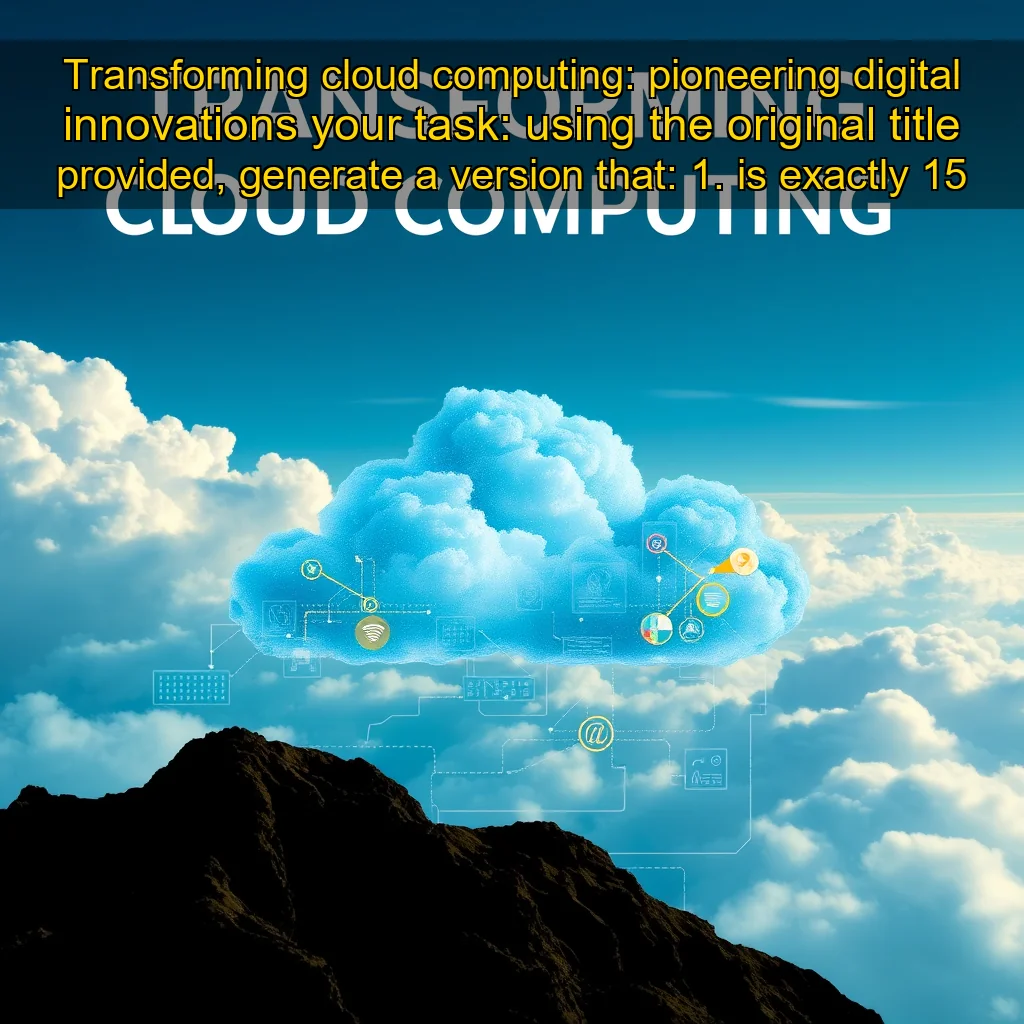
Cloud Computing: Revolutionizing Business Operations with Flexible Service Models and Deployment Strategies.
Cloud Computing: A Comprehensive Analysis
Cloud computing has revolutionized the way businesses operate, and its impact is only expected to grow in the coming years. As a leading expert in cloud strategies, Narasimha Rao Oruganti provides a detailed analysis of the latest advancements in cloud technologies.
Service Models
Cloud computing offers a range of service models that cater to different business needs. The three primary service models are:
Infrastructure as a Service (IaaS): Provides virtualized computing resources, such as servers, storage, and networking. Platform as a Service (PaaS): Offers a complete platform for developing, running, and managing applications. Software as a Service (SaaS): Delivers software applications over the internet, eliminating the need for local installation and maintenance. These service models enable businesses to choose the best fit for their specific requirements, whether it’s infrastructure, application development, or software delivery. ### Deployment Strategies**
Deployment Strategies
Cloud deployment strategies play a crucial role in determining the success of cloud adoption.
SaaS solutions provide a range of benefits, including scalability, flexibility, and cost savings.
The Rise of Advanced Deployment Models
The adoption of advanced deployment models is transforming the way organizations approach cloud investments. With the increasing complexity of cloud environments, companies are seeking more efficient and effective ways to deploy and manage their cloud resources. Advanced deployment models offer a range of benefits, including improved scalability, enhanced security, and reduced costs.
Key Benefits of Advanced Deployment Models
Improved Scalability: Advanced deployment models enable organizations to quickly scale up or down to meet changing business needs. This flexibility is particularly important for companies that experience sudden spikes in demand or need to adapt to changing market conditions. Enhanced Security: Advanced deployment models provide a range of security features, including data encryption, access controls, and monitoring tools. These features help organizations protect their cloud resources from cyber threats and ensure compliance with regulatory requirements. Reduced Costs: Advanced deployment models can help organizations reduce their cloud costs by optimizing resource utilization, eliminating waste, and improving resource allocation.
Benefits of Private Clouds
Private clouds offer numerous benefits to enterprises, including:
Improved workload distribution
Enhanced security and compliance
Increased data protection
Better scalability and flexibility
Reduced costs and improved resource utilization
How Private Clouds Achieve Better Workload Distribution
Private clouds enable enterprises to manage an average of 5.5 cloud platforms, resulting in 84% better workload distribution. This is achieved through the following mechanisms:
Centralized management: Private clouds provide a centralized management platform, allowing enterprises to monitor and manage their cloud resources more efficiently. Automated scaling: Private clouds enable automated scaling, which ensures that resources are allocated and deallocated as needed, resulting in better workload distribution. Load balancing: Private clouds provide load balancing capabilities, which distribute workload across multiple resources, ensuring that no single resource is overwhelmed.
The Rise of Serverless Computing
Serverless computing has revolutionized the way businesses approach computing, offering a paradigm shift in the way applications are built, deployed, and managed. This emerging technology has been gaining traction in recent years, with many organizations adopting it to improve their operational efficiency, scalability, and cost-effectiveness.
Benefits of Serverless Computing
Serverless computing provides several benefits to businesses, including:
Cost Savings: By eliminating the need for servers and infrastructure, businesses can significantly reduce their operational costs. According to a study, serverless platforms can cut operational costs by 54%. Faster Time-to-Market: Serverless computing enables businesses to quickly deploy applications without the need for provisioning and configuring servers. This results in a faster time-to-market, with serverless platforms accelerating it by 77%. Improved Scalability: Serverless computing allows businesses to scale their applications up or down as needed, without the need for expensive server upgrades or downgrades. * Enhanced Security: Serverless computing provides a secure environment for applications, with built-in security features and monitoring tools. ### Zero-Trust Architectures**
Zero-Trust Architectures
Zero-Trust Architectures are a key component of serverless computing, providing a secure and compliant environment for applications. These architectures achieve 91% better compliance with regulatory requirements, making them an attractive option for businesses.
How Zero-Trust Architectures Work
Zero-Trust Architectures work by assuming that all users and devices are untrusted, and verifying their identity and access rights before granting access to applications.
5G networks are expected to support 1 million new jobs in the 5G-enabled industries.
The Rise of Edge Computing
Edge computing is a rapidly growing field that involves processing data closer to its source, reducing latency and improving real-time analytics. By moving data processing to the edge, organizations can reduce the time it takes to analyze data, making it ideal for applications that require immediate insights.
Benefits of Edge Computing
Reduced Latency: Processing data at the edge reduces latency by 81%, enabling real-time analytics and decision-making. Improved Real-time Analytics: With data processed closer to its source, organizations can gain insights faster, making it ideal for applications like IoT, smart cities, and industrial automation. Enhanced Security: By processing data at the edge, organizations can reduce the risk of data breaches and cyber attacks. ## Artificial Intelligence and Machine Learning**
Artificial Intelligence and Machine Learning
Artificial Intelligence (AI) and Machine Learning (ML) are transforming industries with their growing adoption. AI cloud services are experiencing a significant growth rate, with a CAGR of 65%.
The Rise of Cloud Computing
Cloud computing has revolutionized the way businesses operate, making it easier to access and manage data, applications, and services over the internet. This shift has been driven by the increasing demand for scalability, flexibility, and cost-effectiveness. As a result, cloud computing has become an essential tool for organizations across various sectors, including healthcare, finance, and education.
Key Benefits of Cloud Computing
Scalability: Cloud computing allows businesses to scale up or down according to their needs, making it an ideal solution for organizations with fluctuating workloads. Flexibility: Cloud computing enables users to access applications and data from anywhere, at any time, using any device with an internet connection. Cost-effectiveness: Cloud computing eliminates the need for upfront capital expenditures, reducing the financial burden on businesses. Security: Cloud computing providers invest heavily in security measures to protect user data, ensuring a high level of security and compliance.